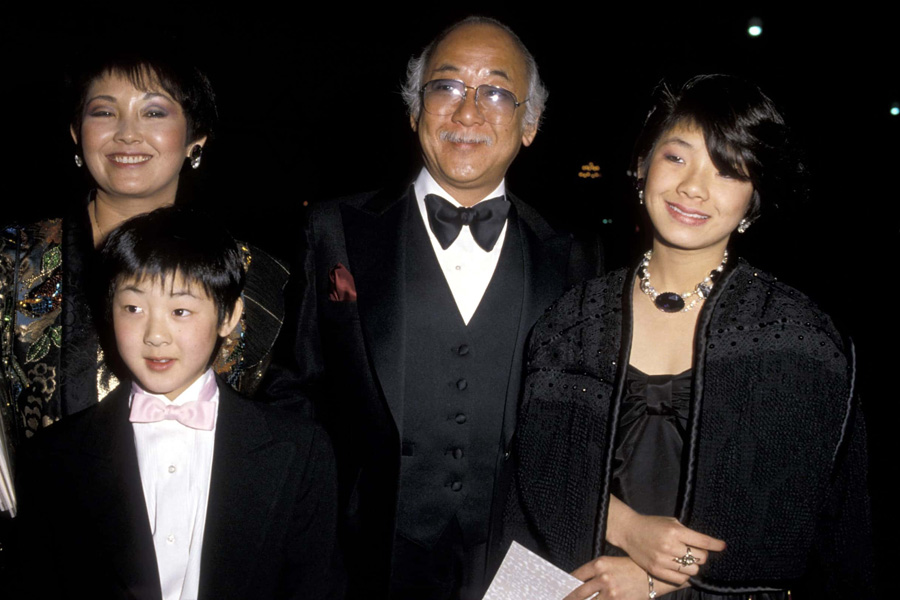
Basic Information
Kathleen Yamachi remains a remarkably private figure in the public memory surrounding Pat Morita. Her name appears most often through family chronology, not professional publicity. She is chiefly recognized as Morita’s first wife and the mother of their daughter, Erin. Their marriage is commonly placed in 1953, and their divorce in 1967. Those dates provide the clearest scaffolding for her public biography. Beyond them, the archive grows sparse and cautious.
| Field | Details |
|---|---|
| Name | Kathleen Yamachi |
| Known For | First wife of actor Noriyuki Pat Morita |
| Marriage | 1953, commonly cited |
| Divorce | 1967 |
| Child | Erin Morita, commonly cited as born in 1954 |
| Public Occupation | Not publicly documented |
| Public Profile | Private individual |
| Later Life | Not reliably documented |
Her story is not expansive in the usual celebrity sense. It is concise, almost ascetic, and that brevity is itself meaningful. Many adjacent names to fame become overexposed. Yamachi did not.
A Private Life Beside a Rising Career
Kathleen Yamachi enters public memory during the early phase of Pat Morita’s adult life. In 1953, he was still years away from the broad recognition that later followed. He had not yet become a television fixture or a cultural touchstone. Their marriage therefore belongs to an earlier, less polished era of his biography.
That timing matters. It places Yamachi near the beginning of a career still under construction. She was part of the domestic world before the camera became central. The public record does not describe her voice, occupation, or ambitions. It simply notes her presence within a family that later became historically visible.
The scarcity of detail should not be mistaken for insignificance. Privacy often leaves fewer artifacts than fame. A person can shape a household, support a partner, and raise a child without leaving a conspicuous paper trail. Yamachi appears to have lived within that quieter register.
Marriage and Family
The marriage of Kathleen Yamachi and Pat Morita is generally dated to 1953. Some references specify June 13, though that detail is less consistently repeated. In 1954, they welcomed a daughter, Erin. That child remains the most consistent public link between Yamachi and Morita.
A family timeline helps organize the few dependable facts.
| Year | Event |
|---|---|
| 1953 | Marriage of Kathleen Yamachi and Noriyuki Pat Morita |
| 1954 | Birth of daughter Erin Morita |
| 1967 | Divorce |
| 1970 | Morita’s later remarriage begins |
| 1994 | Morita enters a third marriage |
| 2005 | Morita dies |
This sequence shows how narrowly Yamachi’s public identity is framed. Her mention is anchored to marriage and motherhood. Those markers are enough to place her in history, yet not enough to expose her private world. She remains present, but not available.
Erin’s birth also shapes how Yamachi is remembered. A child often becomes the most durable public connection in a family record. That is true here. Her role as mother is one of the few stable points repeated across summaries. It is a factual anchor, and it carries real human weight.
The Years Between 1953 and 1967
The span from 1953 to 1967 contains the entirety of Yamachi’s documented marriage. Those fourteen years cover a notable stretch in American cultural change. Television, popular music, and performance circuits were all shifting rapidly. Morita’s later fame would emerge from that changing terrain.
For Yamachi, however, the record offers no professional narrative. There are no verified accounts of stage work, screen work, or public commentary. There are no sustained interviews, no documented public campaigns, and no confirmed memoir-like statements. The available picture is therefore restrained.
That restraint should be read carefully. Some biographies are thin because they are fabricated. Others are thin because the person chose distance from publicity. In Yamachi’s case, the second explanation appears more plausible. Her public life seems to have been limited, deliberate, or both.
The absence of spectacle can itself be illuminating. It suggests a life organized around ordinary obligations rather than public performance. In a culture that often treats visibility as proof of value, that is an important corrective. Not every consequential life becomes theatrical.
After the Divorce
By 1967, the marriage ended. After that point, public references to Kathleen Yamachi become even more limited. Morita’s later biography is widely traced through entertainment milestones, later marriages, and renewed fame. Yamachi, in contrast, recedes into privacy.
This later silence is not an oversight. It is the defining feature of what can be responsibly said about her. Reliable public records do not establish her occupation, residence, or later family life. Her birthdate is not securely documented in mainstream references. Her parents, education, and later circumstances remain unconfirmed.
Such uncertainty invites restraint. It is easy to convert a blank space into fiction. It is harder, and more honest, to acknowledge the limits of the record. Yamachi’s post-divorce life appears to have unfolded away from public inspection. That fact is part of her biography.
The internet often rewards overstatement. It repackages weak repetition as certainty. A disciplined reading does the opposite. It preserves what is known and declines what is not. Kathleen Yamachi’s story requires that discipline.
Pat Morita’s Wider Family Context
Yamachi’s place in public narrative becomes clearer when set beside Morita’s later family life. He later married Yukiye Kitahara from 1970 to 1989. He then married Evelyn Guerrero from 1994 until 2005. He also had two daughters in the later family branch, Aly and Tia.
This broader context does not enlarge Yamachi’s biography much. Instead, it narrows the frame around her. She belongs to an earlier chapter, one defined by a single marriage and one daughter. Her public footprint is therefore distinct from Morita’s later domestic history.
That distinction matters because popular retellings sometimes flatten family chronology. They attach everyone to everything. A more careful account separates the branches. Yamachi’s story is not the same as Morita’s subsequent marriages. She is linked by chronology, not by later publicity.
The following table clarifies the family arc.
| Period | Family Context |
|---|---|
| 1953 to 1967 | Kathleen Yamachi and Pat Morita marriage |
| 1954 onward | Erin as their daughter |
| 1970 to 1989 | Morita and Yukiye Kitahara |
| 1994 to 2005 | Morita and Evelyn Guerrero |
A table cannot replace biography. It can, however, prevent confusion. In Yamachi’s case, it preserves the limited facts without theatrical enlargement.
Reading the Sparse Record
A sparse record deserves careful interpretation. When a person appears only in relation to another’s fame, there is a temptation to infer hidden drama. That temptation should be resisted. No verified public evidence supports colorful speculation about Yamachi’s inner life.
The more responsible reading is simpler. Kathleen Yamachi likely lived privately, outside the machinery of public celebrity. She was present during a crucial early period in Morita’s life. She became a mother in 1954. Her marriage ended in 1967. After that, the public record thins out markedly.
This kind of biography is less ornate than readers often expect. Yet it can still be complete in its own terms. Completeness does not always mean abundance. Sometimes it means respecting the edges of available knowledge. With Yamachi, the edges are clean and firm.
The story also reveals a broader truth about fame. Not every person connected to a public figure becomes public property. Some remain partially invisible by choice or circumstance. Their dignity lies partly in that distance.
Key Takeaways
Kathleen Yamachi is best understood through a small set of durable facts. She was the first wife of Pat Morita, and they married in 1953. Their daughter, Erin, was born in 1954. The marriage ended in 1967. After that, her life remained largely outside public documentation.
Her biography is notable precisely because it resists inflation. There is no verified public career narrative. There is no confirmed archive of interviews or public statements. Her later life is not reliably recorded in mainstream public memory. That silence is not emptiness. It is evidence of a private existence that did not seek public consumption.
The most honest portrait of Yamachi is therefore measured. She stands at the edge of a much larger entertainment story. She appears in family history, then withdraws from view. What remains is a concise record, and that record deserves to be handled with exactness.